
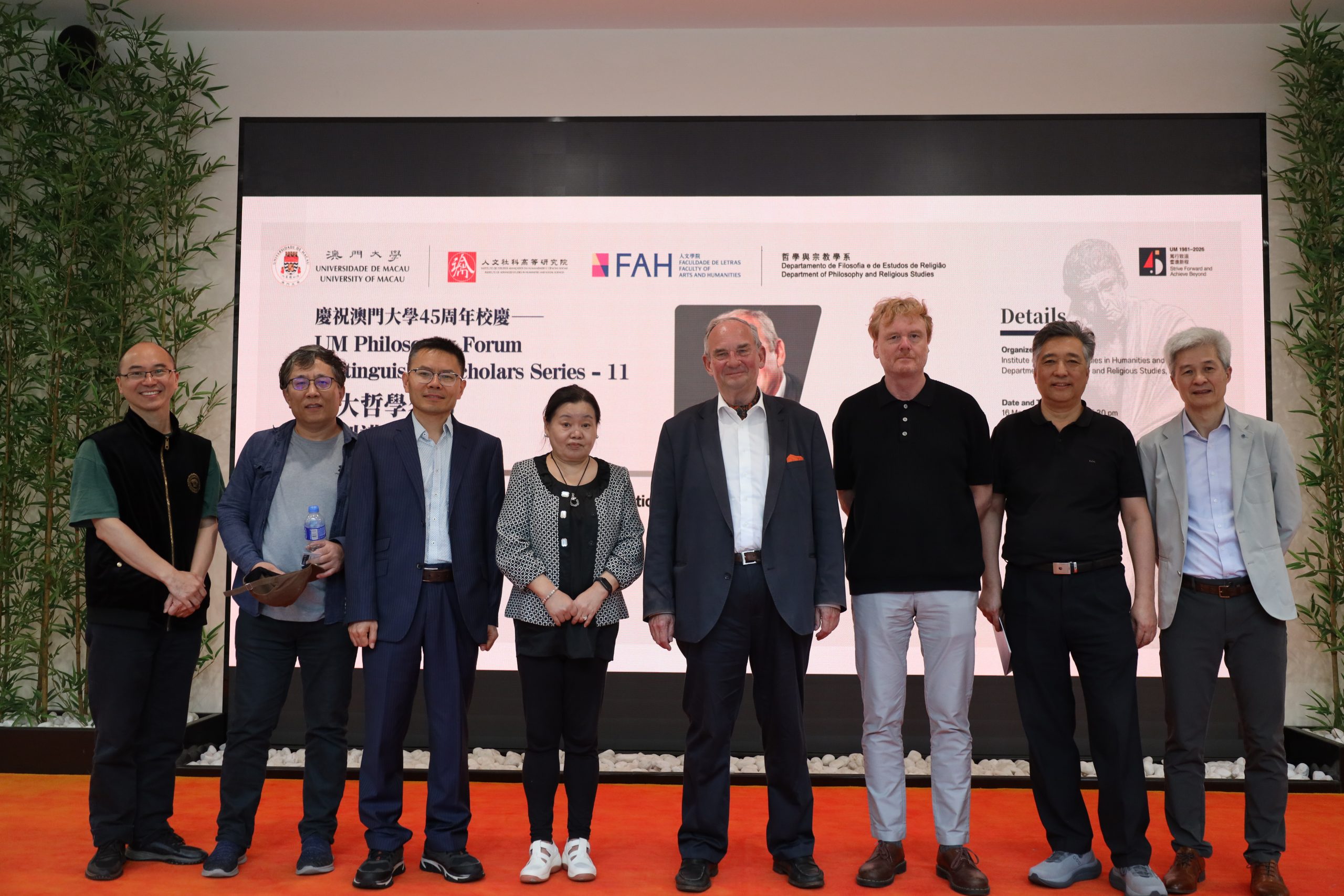
On the afternoon of March 16, 2026, the “UM Distinguished Philosophers Lecture Series – 11”, co-hosted by the Institute of Advanced Studies in Humanities and Social Sciences and the Department of Philosophy and Religious Studies of the Faculty of Arts and Humanities, University of Macau (UM), was successfully held at Lecture Theatre G011, Cultural Building (E34).
Invited as the keynote speaker for this lecture was Professor Walter Schweidler, Chair of Philosophy at the University of Eichstätt-Ingolstadt, Germany. He delivered a presentation themed Slaves Within Ourselves: Political Legitimacy in the Context of Utilitarian Culture. The lecture was moderated by Professor Hans-Georg Moeller from the Department of Philosophy and Religious Studies, Faculty of Arts and Humanities, UM. Professor Ellen Zhang, Professor and Head of the Department of Philosophy and Religious Studies, Faculty of Arts and Humanities, UM, and Associate Professor Zhai Xiaobo, Associate Professor of the Department of Global Legal Studies and Associate Dean (Research) of the Faculty of Law, UM, served as the discussants. The entire lecture was conducted in English.
At the beginning of the lecture, Professor Walter Schweidler elaborated on the classic argument in Aristotle’s Politics that “slavery is part of human nature”. He pointed out that this proposition still holds systematic significance for political philosophy and even for the discipline of political science itself, and analyzed its core implications from both historical and philosophical dimensions. From a historical perspective, the ancient Athenian polis, as the realistic model for Aristotle’s theory, had a slave-owning state structure whose concept of freedom still exerts an indirect yet decisive influence on understanding the political legitimacy and rationality of modern nations. From a philosophical perspective, this theory essentially anchors the core elements of citizenship, which defines the boundary between free persons and slaves: the actions and thinking of free persons are rooted in their own experiences, whereas slaves are deprived of this experiential foundation.
Then, Professor Schweidler further analyzed the core implication of slavery as “the price of freedom” in Aristotle’s political model. He noted that schole (leisure) of the citizens in the ancient Greek polis was the key to achieving political freedom and living a “good life”, and such leisure was premised on the forced labor of slaves. Aristotle regarded physical labor and wage labor as “base” and argued that such labor would corrupt the soul and intellect of free persons, making slavery a necessary condition for the realization of political freedom in the polis. Building on this, the professor shifted his focus to modern society, pointing out that although modern society has abandoned chattel slavery, it has replaced it with wage labor as a “form of labor for others”. To gain mutual recognition of freedom and equality, citizens have to pay the price of lifelong wage labor, thus being trapped in the logical framework of utilitarian culture. Professor Schweidler emphasized that the true “good life” is a cultural achievement rather than an economic product, whose core lies in the ordo amoris (order of love)—an interpersonal order based on love and responsibility. This order is interconnected with the core ethical relationships of Confucianism and also serves as the socio-cultural prerequisite for political institutions. If social rationality is absolutely equated with a utilitarian system centered on desire satisfaction, it would amount to a tyranny over oneself. To uphold human nature and the good life is the embodiment of the “politicalness” of citizens as free subjects.
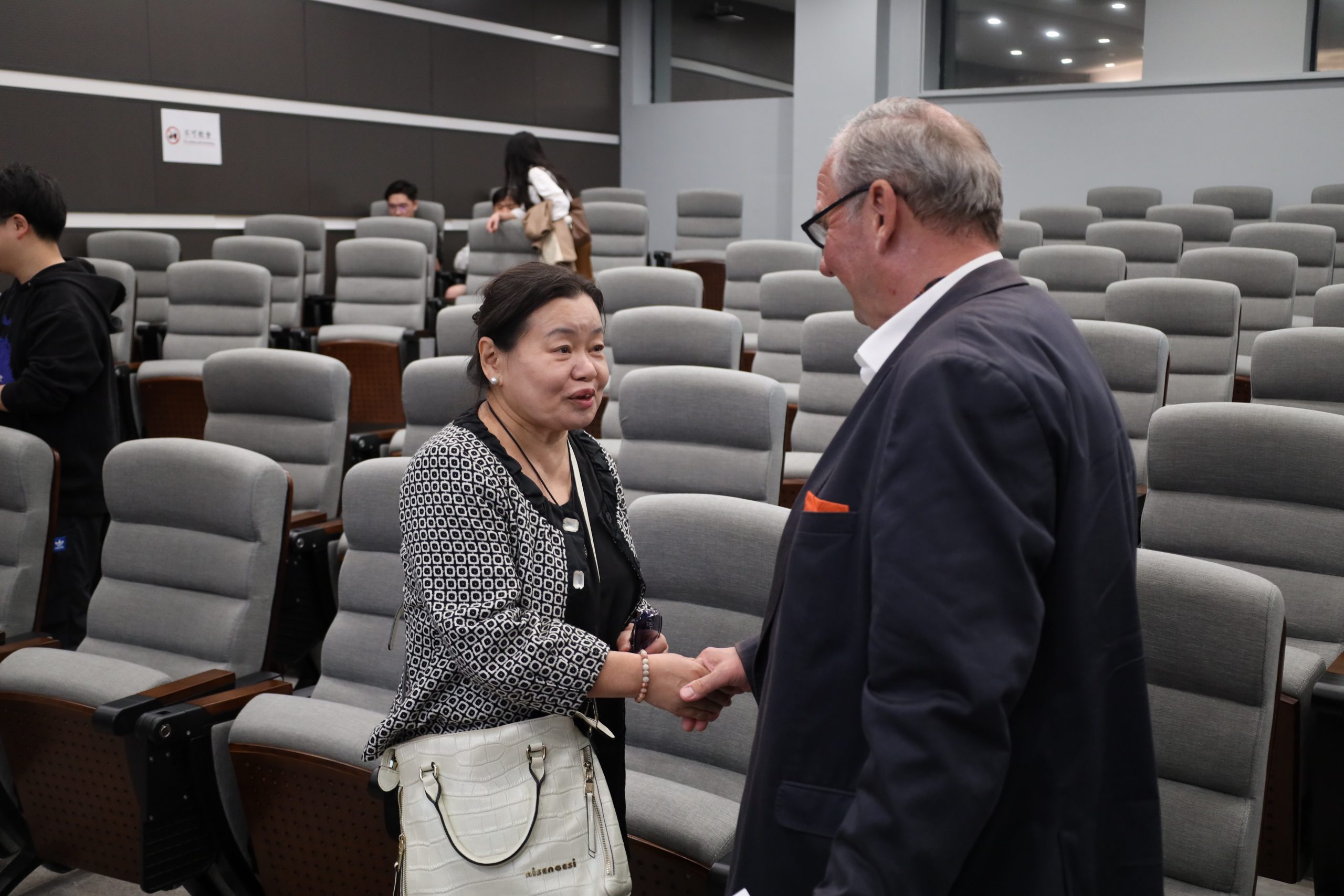
During the Q&A session, Professor Schweidler, together with the two discussants and the faculty and students present, engaged in lively interactions and in-depth discussions on topics such as the modern value of Aristotle’s political theory, the practical impact of utilitarian culture, and the “self-enslavement” in modern society.
The lecture attracted a large number of UM scholars and students, creating a vibrant atmosphere of critical thinking. It not only provided faculty and students with new perspectives and diverse angles to examine modern political and cultural predicaments from the lens of classical philosophy, but also further promoted the exchange and dialogue between Chinese and Western philosophical traditions.




UM Philosophy Forum Distinguished Scholars Series – 11
Video Recap