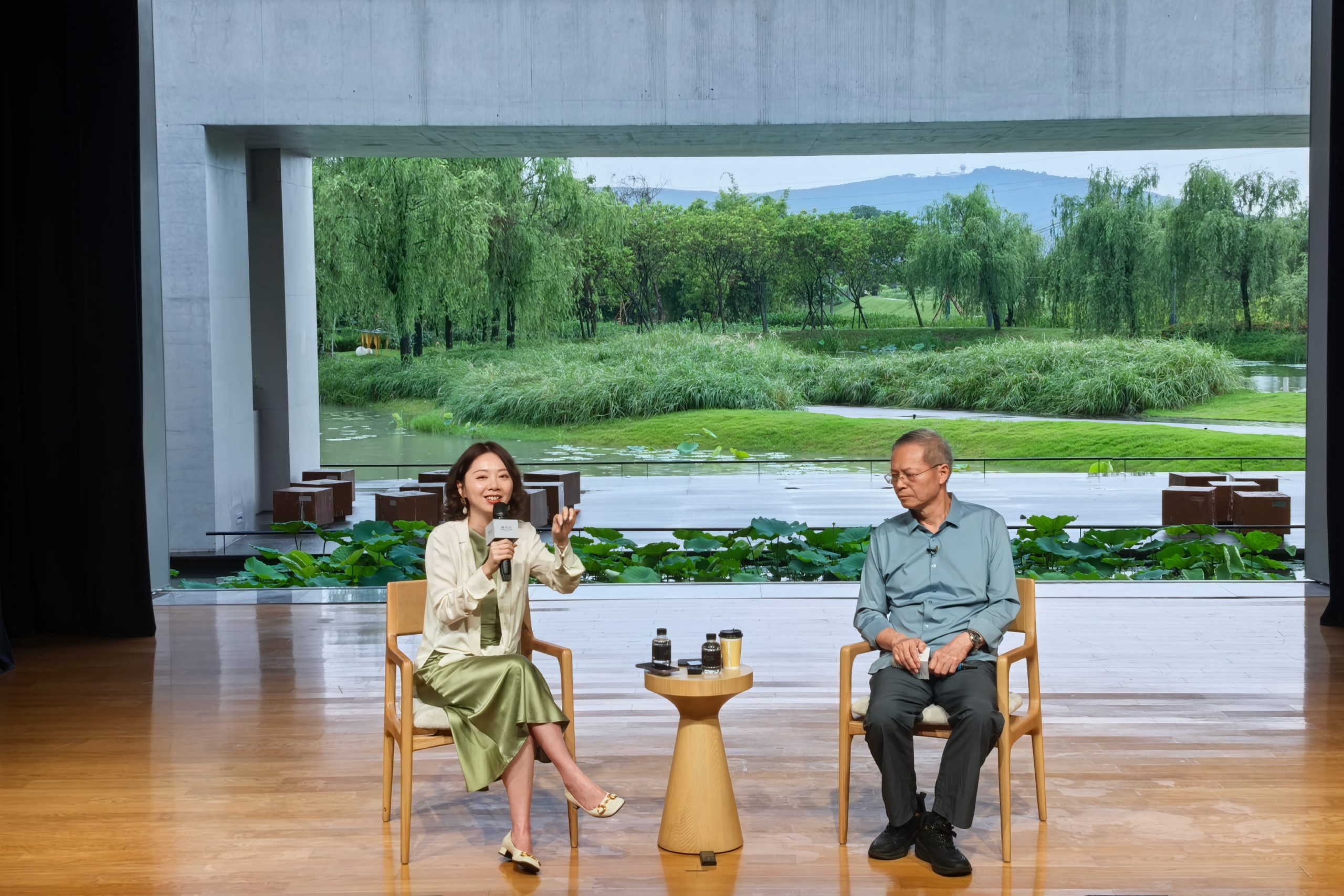

On May 23, 2026, a dialogue jointly organized by the Institute of Advanced Studies in Humanities (IASH) at Sun Yat-sen University and the Institute of Advanced Studies in Humanities and Social Sciences (IAS) at the University of Macau (UM) was successfully held at the Chunyangtai Theatre in Guangzhou. Centered around the theme “Wild Cities: Tea Houses, Urban Villages, and the Wisdom of Survival,” the event was co-moderated by Professor Di Wang, Chair Professor of the Department of History in the FAH and Associate Director of IAS at the University of Macau (UM), and Professor Zheng Lin, Associate Professor of the Department of Chinese Language and Literature and Associate Dean of IASH at Sun Yat-sen University. The dialogue drew a diverse audience of experts, scholars, and young students from fields such as history and cultural studies to engage in deep discussions on urban spaces, grassroots creativity, and historical writing.
At the beginning of the lecture, Professor Wang shared the evolution of his academic perspective. He noted that his early work, Striding Out of a Closed World: Social Transformation of the Upper Yangzi Region, 1644-1911, was influenced by the concept of linear evolutionary modernity, adopting a top-down macro-perspective that did not place individual life stories at the core of his research. However, after engaging with new cultural history and microhistory, he decisively pivoted toward a bottom-up approach. He subsequently focused his research on grassroots daily life and social networks—such as “street culture,” “tea houses,” and “the Gowned Brothers” (Paoge)—advancing the academic proposition of “putting history under the microscope” to restore individual experiences often obscured by grand narratives.
Professor Lin turned the focus toward the unique morphology of urban villages in Guangzhou and the grassroots culture they cultivate. She analyzed that, unlike the marginalized shantytowns in other cities, Guangzhou’s urban villages are mostly embedded within the bustling city center. Their affordable living costs not only provided a solid foundation of support for the “factory of the world” but also nurtured avant-garde, grassroots artistic forces that grew organically, such as the indie rock band Wu Tiao Ren. Professor Lin emphasized that, compared to top-down, highly regulated planned spaces, the ecosystem that grows resiliently at the margins of institutions and regulations exhibits a more robust vitality and dynamic creativity.
During the interactive dialogue session, the two scholars raised profound questions regarding “the value and boundaries of literary materials as historical sources.” They agreed that while literary creation can effectively fill the voids left by official orthodox histories, researchers must maintain a sharp critical awareness. Scholars need to be vigilant against the class biases inherent in elite narratives while carefully delineating the boundaries between fictional imagination and historical truth.
At the conclusion of the dialogue, Professor Wang called upon the audience: ordinary people should courageously shoulder the responsibility of recording daily life. He maintained that history should not be the exclusive domain of emperors, generals, and ministers; as long as every individual persists in writing about the people and events around them, everyone can leave behind invaluable folk archives for future generations.
This dialogue marks the first major academic collaboration between IAS (UM) and IASH (SYSU) this year. Serving as a promising starting point, the two institutes will further deepen their academic exchanges and strategic cooperation. Future plans include a joint field trip spanning Macao, Zhuhai, and Zhongshan in July, as well as co-hosting the 4th Guangdong-Hong Kong-Macao Greater Bay Area Interdisciplinary Doctoral Forum in August, aiming to jointly advance the flourishing development of the humanities and social sciences academic community in the Guangdong-Hong Kong-Macao Greater Bay Area.